Pink Floyd
Nieuwe burenPink Floyd is more than Peter’s favorite band: it becomes a measure of the life he once wanted, a memory of music’s power to absorb him, and, in his unraveling, a source of revelations he believes are meant for him. The band’s actual songs and Peter’s changing interpretations remain distinct. What shifts is his way of listening—from admiring guitar sound and performance to searching the lyrics for explanations, warnings, and hope.
Early Musical Ideal
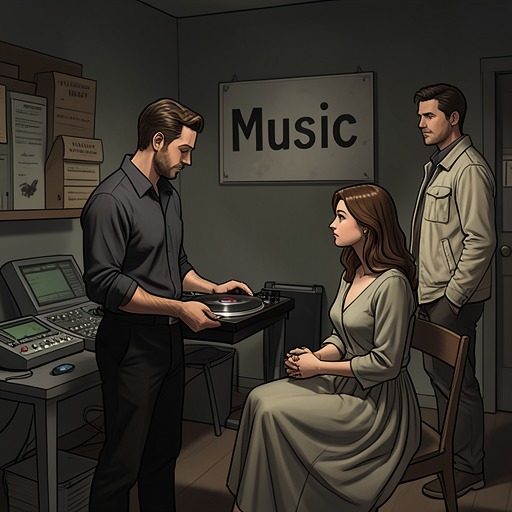
As a teenager, Peter imagined making a life in music. He spent his money on DJ equipment and advertised himself on silver-colored cards as DJ Peter, playing school parties, exam celebrations, weddings, and birthdays for a hundred guilders an evening. The earnings paid for guitar lessons; DJ work was a means toward what he considered his real ambition, becoming the guitarist in a rock band.
Peter’s musical allegiance set him apart from classmates who admired Boy George and Duran Duran. He preferred Led Zeppelin, the Stones, Deep Purple, Jimi Hendrix, and especially Pink Floyd. He revered guitarists as the band’s true heroes: self-contained, commanding performers who seemed to bend the music and the audience to their will. In this fantasy of musical authority, the rest of the band supplied the rhythm while the soloist stood apart. Peter practiced obsessively in a bedroom covered with posters of Led Zeppelin, Jimi, Keith, and Ritchie Blackmore.
That ambition met a decisive failure when Peter auditioned as a guitarist for the locally popular band On the Road. So nervous that he vomited before he could play a note, he was told he lacked stage presence and should address his fear of failure. He never did. Looking back, he frames the pattern as a paradox: fear of failing can itself produce failure, while the possibility of succeeding may be even more frightening. Pink Floyd belongs to the ideal against which this thwarted ambition takes shape—the image of musicians who appear unafraid, absorbed in performance, and master of their craft.
The Concert and the Lost Capacity to Be Moved
Peter’s last pop concert before the events of the novel was Pink Floyd’s Division Bell tour performance at De Kuip in 1994. He remembers it as an overwhelming spectacle: two hours of goosebumps and what he calls ultimate perfection. The experience was so complete that afterward he did not want to see another band. He still regards Pink Floyd as the world’s greatest band and “Wish You Were Here” as the finest song ever written.
That memory acquires force through its contrast with Peter’s later estrangement from crowds and spectacle. When Steef takes him to see U2 at the Amsterdam ArenA, Peter knows the stadium from his former work as a sports reporter. Its anticipation stirs an old excitement, but he also remembers becoming sick of the masses, queues, hot dogs, litter, flags, and aggression. He cannot now lose himself in a shared event as he once did at Pink Floyd, even though he wants to. His recollection does not prove that the earlier concert was free of the spectacle he later dislikes; Peter himself allows that it may have been similar. Instead, the contrast turns on the person he was then: still able to feel part of a crowd and be reached by music.
Steef’s taste makes Pink Floyd a recurring point of friendly antagonism. In weekly arguments at Steef’s workshop, Steef dismisses David Gilmour and Roger Waters as overrated, aging practitioners of self-indulgent progressive rock, while Peter disparages The Edge’s guitar playing beside the virtuosity of Ritchie Blackmore and Jimi Hendrix. Steef calls Peter nostalgic and stuck in adolescence; Peter answers by treating U2’s contemporary relevance and Bono’s public activism with skepticism. Their dispute is not simply about technique. It stages opposing accounts of musical value: Peter’s attachment to guitar mastery and a remembered past against Steef’s defense of a current band whose music, in his view, also tries to do good in the world.
Steef puts money behind that challenge, buying black-market tickets for the U2 concert for 125 euros each, asking for no repayment if Peter will promise to listen openly to Bono’s message. Peter agrees. The gesture brings him into the same stadium where his relationship to crowds has changed, and places his devotion to Pink Floyd beside Steef’s faith in U2 without resolving their disagreement.
Songs Reheard as Personal Messages
For much of his life, Peter says, he listened to Pink Floyd for melody and guitars rather than lyrics. Later, songs seem to tumble through his thoughts, and he begins pulling CDs from the rack as though each album contains something addressed to him. He feels that he has remained faithful to his old heroes and that their message has finally reached him. The change is less a discovery about the band than a transformation in Peter’s listening: music once prized for sound becomes a system through which he tries to read his own life.
“Wish You Were Here” is central to that reinterpretation. Its image of two lost souls moving through the same enclosed, repetitive existence resonates with Peter as a description of himself and his relationship. At home, he decides the song is about God: in his reading, its longing expresses the wish that a God exists, someone who could help, provide rules for living, and give events meaning. He imagines that God might reveal himself to people who call out in need, and then begs for such a revelation. The song does not supply a confirmed divine answer; the passage presents Peter’s need to find one.
The same search for hidden meaning takes a more threatening turn after Steef and the others leave. Peter concludes that they have deceived him, reads Steef’s behavior as evidence of danger, and decides that he must protect himself with a weapon. At the computer, over a triple espresso, he plays The Dark Side of the Moon. The heartbeat in the introduction and the distant helicopter become sounds he scrutinizes for a message; he replays the passage louder and again because he cannot make it out. Pink Floyd is therefore woven into both sides of his crisis: the music offers a possible language for interpreting events, but his certainty that he is being tested and addressed also reveals how far his thinking has shifted from listening toward suspicion.
Music, Marriage, and the Possibility of Beginning Again
Peter’s musical interpretations continue to change with his hopes for Eva. While she is away, he smokes a joint but finds that it only makes him hear more music. Songs and their release dates seem to test him, and he can answer those tests; meanwhile, he questions why he works as a sports editor, concluding that it is a well-paid job maintained for his family and mortgage rather than a dream. Music connects the abandoned creative ambition of his youth to his sense that adult life has narrowed into obligation.
When Peter imagines Eva returning, he pictures a shared break with that life. He might resign, leave De Zonnepolder, go abroad with her, and start something together—perhaps the beach café they once dreamed of. His appeal is to their partnership: a good team should not be split apart. He reaches for bands as examples of groups that belong together, naming ABBA, Guns N’ Roses, Pink Floyd, and The Beatles, and treats that comparison as evidence that there is still hope if he and Eva can create a new purpose. The analogy is not a plan guaranteed to work; it is Peter’s effort to turn musical loyalty into a language for marital repair.
Across these episodes, Pink Floyd marks the distance between Peter’s former capacity for absorption and his later hunger for certainty. The band begins as an ideal of individual mastery, becomes the memory of a concert at which he could feel part of something larger, and is then recruited into interpretations of loss, danger, faith, and reconciliation. Its importance lies in that recurrence: the same music can preserve a real emotional attachment while Peter’s increasingly urgent readings of it expose the instability of the meanings he needs it to provide.